
Products & Services
Deionized (DI) Systems
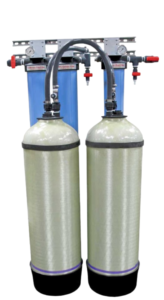
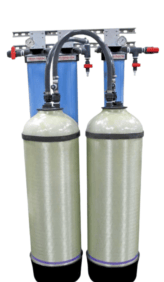
A deionization water system is used to generate extremely pure water. In simple terms, deionization is the removal of undesirable ions from water and works through a process called ion exchange. It can be used alone or conjunction with other technologies, depending on the complexity of the system such as reverse osmosis, ultraviolet (UV) disinfection, and extensive water quality monitoring equipment.
PIIWAR water deionizer system design achieves 18 mega-ohms resistivity. It allows us to deliver DI water that meets the most stringent protocols.
Deionization systems work by replacing negative and positive molecules in the water with hydrogen (positive) and hydroxyl (negative) through a process called ion exchange. In the context of water purification, ion exchange is a rapid and reversible process in which impurity ions present in the water are replaced by ions released by an ion exchange resin. When the ion exchange resin beads become saturated with undesired ions they can be regenerated and used again.
How DI Water Works
For many laboratory and industrial applications, high-purity water which is essentially free from ionic contaminants is required. Water of this quality can be produced by a di water system. The two most common types of deionization are:
Two-bed deionization
The two bed deionizer consists of two vessels – cation & anion ex-changers are connected in series. Separate bed deionizers can have a higher exchange capacity and less complicated operating procedure. Water flows through the cation column, whereupon all the cations are exchanged for hydrogen ions. The same principle applies when considering anion-exchange. The decationised water then flows through the anion column. This time, all the negatively charged ions are exchanged for hydroxide ions which then combine with the hydrogen ions to form water (H2O).
Mixed-bed deionization
The mixed bed deionizer – cation & anion ex-changers are combined and mixed in a single vessel. Mixed bed can have a higher water quality, lower rinse water requirements, and more neutral pH than two bed systems. Although more efficient in purifying the incoming feedwater, mixed-bed plants are more sensitive to impurities in the water supply and involve a more complicated regeneration process. Mixed-bed deionizers are normally used to ‘polish’ the water to higher levels of purity after it has been initially treated by either a two-bed deionizer or a reverse osmosis unit.
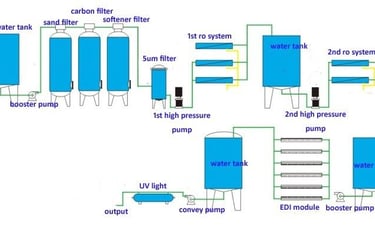
ELECTRODEIONIZATION
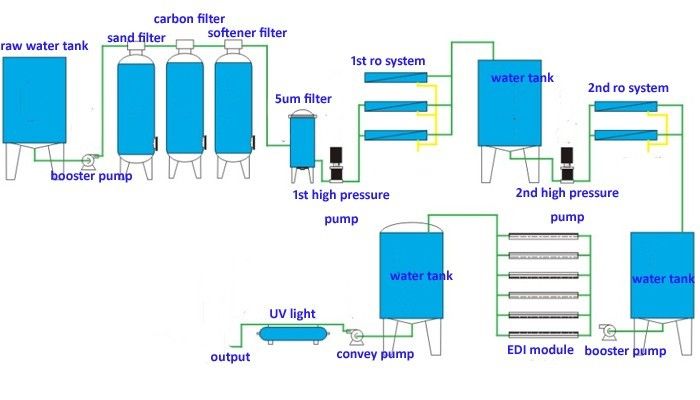
known as EDI or CDI (Continuous Deionization) this system removes ions from aqueous streams that utilizes DC electricity, ion ex-change membranes and ion exchange resin to deionize water. Electric potential regenerates resin with less cost, since it only requires electricity, while conventional ion exchange water treatment systems need large vessels, acid/caustic injection systems, and etc.
Key Features:
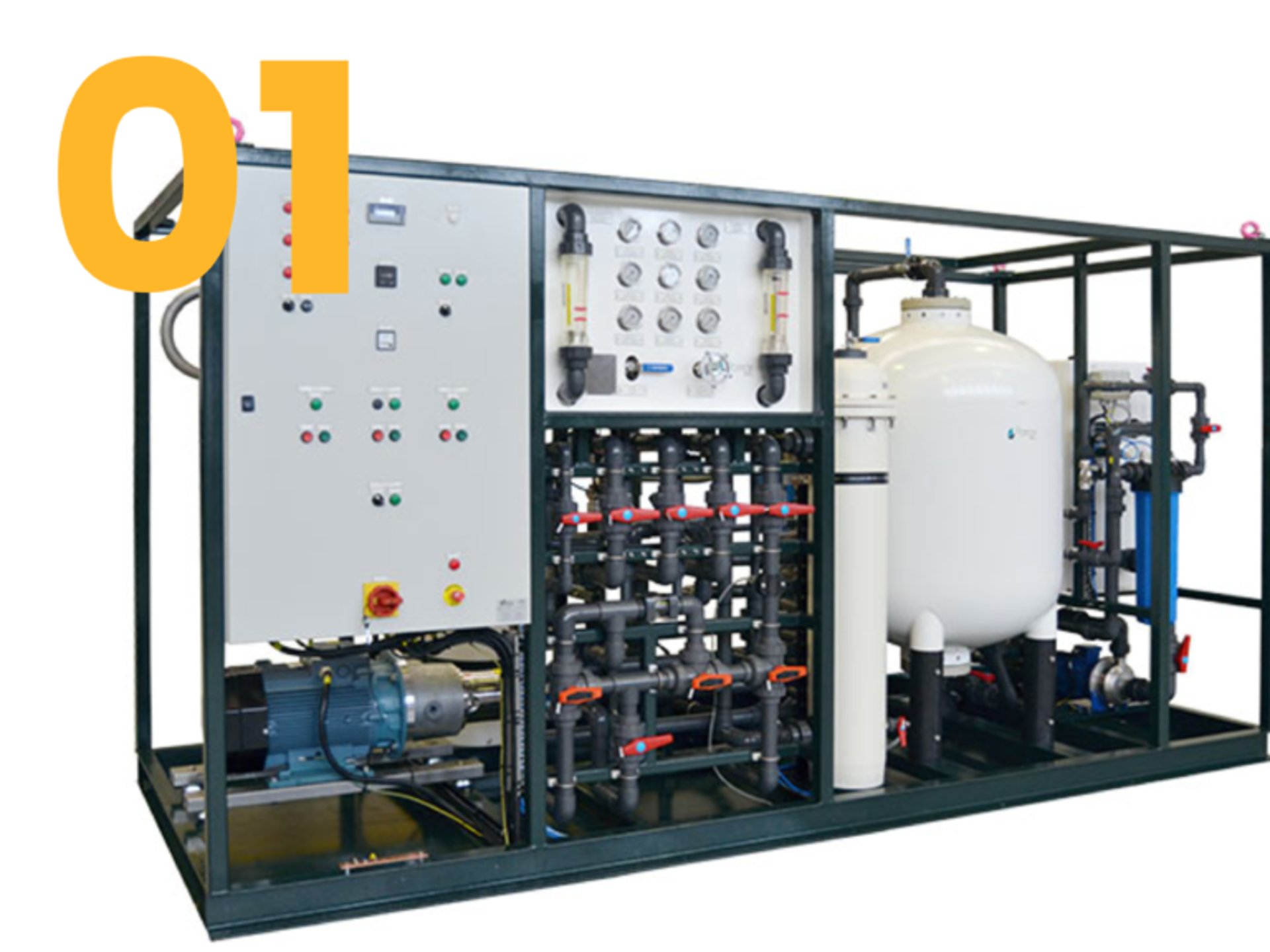
PLC + Simens HMI touch screen automatic control
All pipes are orbital welding, double-sided molding, smoothly
Pretreatment filter and RO system compact design, more beautiful and save space
Activated carbon filter and distribution loop system pasteurization
Conductivity, PH, Temperature, Flow online monitor
Separate CIP system for RO membrane cleaning
System fault automatic alarm
Self cleaning procedure for RO membrane flush at each time start the machine
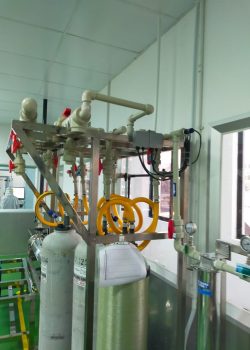
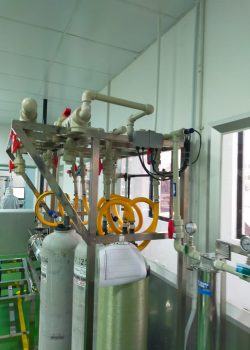
Customized EDI/CDI Unit
Sectors
Drinking water
Food & beverage
Power plant
Pharmaceuticals
Petrochemical industry
Optical glass industry
Metallurgy
Agriculture – Boiler feed
Advantages:
Can reduce the conductivity of water
Remove all charged substances including heavy metals in the water
Fresh water quality, clean yet healthy, transparent process-ing and meet global requirements
High technical, stable operation, easy to maintain, long life time